Master the SEO Funnel and Boost Conversions Fast
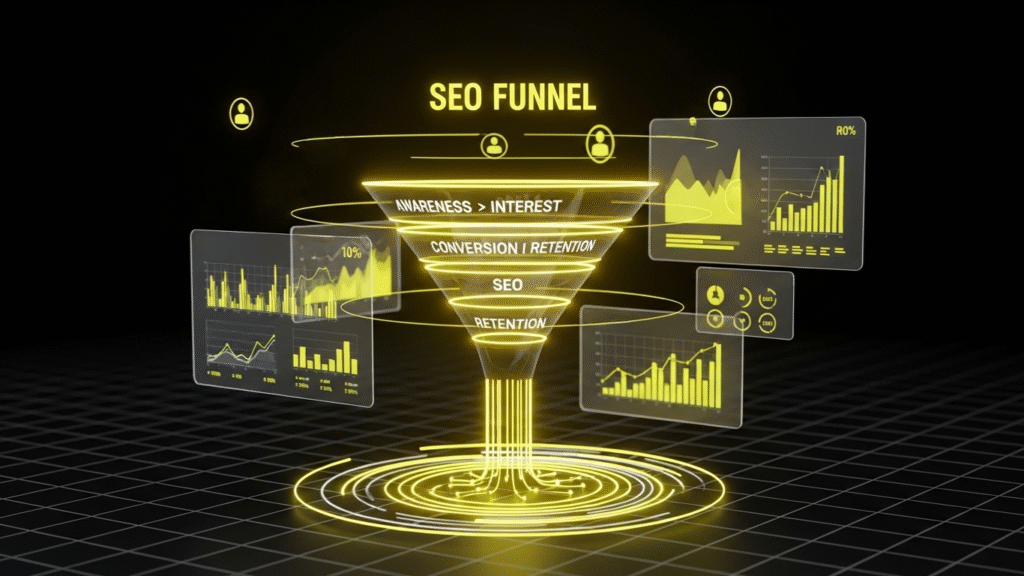
When someone types in “best CRM tool”, “how to lose weight”, or “SEO agency near me”, this search marks the start of a journey. Some visitors are not looking to buy, and many are looking for answers. This journey, governed through content and context, is known as “the” SEO funnel.
At Garage2Global, we don’t throw up content on the internet and hope someone clicks. We develop a complete SEO funnel that guides people from their awareness of the site to deciding to convert sceptical customers into leads and leads into loyal customers. In this article, I’ll take you through the ideas and stages as well as plans for the year 2025, the ways we can assist you in building it, and all the information you’ll need to put out today.
What is an SEO Funnel?
An SEO funnel is the process of strategically using SEO techniques to move a potential customer through the stages of the marketing funnel: awareness, consideration, conversion, and retention.
Unlike traditional funnels that rely heavily on paid ads or email marketing, the SEO funnel focuses on organic search traffic. It ensures that each piece of content, keyword, and backlink contributes to guiding users toward your business goals.
The Stages of the SEO Funnel
Let’s break down the current SEO funnel in its key phases (adapted to the current search environment):
Awareness Stage (Top of Funnel)
On top of that list, users are often asking general, curious questions like “What is SEO?”, “How does digital marketing work?”, or “What are the benefits of content marketing?” They’re gathering information and are not yet ready to buy.
The types of content here are:
- Informative blog posts
- How-to guides
- Explainers
- Glossaries
The aim is to draw attention to your website, establish trust and establish your brand.
Consideration/Evaluation Stage (Middle of Funnel)
Today, users can compare the alternatives. They can be searching for “SEO vs PPC costs”, “best agencies in [city]”, or “how to pick a content marketing firm”.
The contents here include:
- Comparative articles
- Case studies
- Tutorials/walkthroughs
- Service overview pages
The awareness content is linked into these evaluations and guides users deeper.
Decision / Conversion Stage (Bottom of Funnel)
At this point the user is prepared to move forward. They look up “hire SEO agency”, “contact SEO consultant”, and “pricing SEO services“.
Content here:
- Service pages
- Pages that land with clearly defined CTAs
- Contact forms, consultations, demos
It is here that conversions take place. Your funnel should provide users with confidence, clarity and the desire to succeed.
Post-Conversion / Retention (Beyond the Funnel)
The funnel doesn’t stop at conversion. To keep and increase sales, you can make use of
- Onboarding guides
- Customer assistance centres
- Content for follow-up
- Programmes to reward loyalty
A well-oiled funnel will keep your customers engaged and not distracted.
Why SEO Funnels Are Even More Essential in 2025
AI & Answer Engines Alter the Search Game
Google’s AI overviews and generative searches frequently answer questions directly, which means fewer visitors to your website. Your site’s content should not just be ranked but also structured so that it can be included in the AI summary.
Zero-Click Searches Are the New Normal
Today, the majority of searches do not result in the click of a different website. Your funnel must be able to provide value, even in short snippets of content, of featured answers, and incomplete content.
Content Saturation Demands Depth & Structure
Generic content gets drowned out by the noise. To be noticed on your channel, it must be meticulously mapped, making your content uniquely structured, well-structured, and semantically linked.
Intent Focus Maximises Conversions
If you can align your content with your search intention (awareness and comparison or purchase), you can better meet user requirements, reducing bounces, increasing the time on-site, and boosting the efficiency of conversion.
How to Build an Effective SEO Funnel
Here’s how to build an optimal funnel that includes everything from SEO architecture to conversion.
Crawl, Render, Index Foundation
Before your funnel is able to function, Google must discover and comprehend your pages. This means:
- A simple crawl architecture (sitemaps, internal links, sitemaps)
- Proper rendering of web pages (especially in the case of JS frameworks)
- Effective indexing, making sure your content is included in Google’s index
If the pages aren’t crawled or indexed, they aren’t able to direct users.
On-Page & Semantic Optimization
Every stage’s content has to be optimised.
- Meta descriptions, titles, and headings are aligned to stage-specific questions.
- Keywords that are semantically related to entities
- Schema markup (FAQ review, how-to) to increase the snippet’s possibility of being eligible
- The clear internal link will direct users further into the funnel.
Content Strategy & Clusters
Plan out the pillar pages of each funnel’s major topic (e.g., “SEO fundamentals”, “SEO services comparison”, and “hire SEO consultant”) and help them by providing cluster content that provides answers to more complex questions. Link clusters into pillars and pillars to your service pages, such as [SEO Services], [Consulting Services], and [Technical SEO].
Conversion Path & UX Optimisation
Be sure that every page contains an obvious call to action (CTA). Utilise contact prompts, forms, or calculators as well as flow guides. Customise CTAs based on funnel stages (e.g., “Learn More” at awareness, “Request Quote” at decision).
Monitoring, Analysis & Iteration
Measure funnel metrics such as how many users go through the funnel from stage one to the next drop-off points and conversion rates. Utilise tools like Google Analytics, Search Console, and heat maps. Reduce content that isn’t performing, improve CTA, and refresh clusters frequently.
How Garage2Global Implements SEO Funnels for You
Here’s how we create the complete SEO funnel strategy if you join us:
- Discovery & Funnel Mapping: Know your company, its offerings, customer personas, and funnel stages.
- Technical Audit & Setup: Repair issues with crawls, rendering indexing gaps.
- Keyword & Intent Planning: Find the best keywords for funnel stages (awareness and evaluation, then conversion).
- Content Creation & Linking: Create pillar and cluster content. Interlink by using clearly defined anchor text on the service pages.
- Page-Level Optimisation: Improve on-page SEO: title, meta, headings, schema, and speed.
- UX & Conversion Design: Make sure that each page directs users to the desired goal (contact or registration, etc.).
- Monitoring & Optimization: Utilize analytics to repair leaks and refresh content, or conduct A/B testing.
With this funnel set up, don’t look for instant miracles, but do expect better quality traffic as well as better user experience and higher quality conversions over time.
Measuring SEO Funnel Performance
Tracking performance ensures your SEO funnel is delivering results. Important metrics include:
- Organic traffic by funnel stage
- Bounce rate and time on page
- Conversion rate and form submissions
- Keyword rankings and SERP visibility
- Backlink quality and referral traffic
Tools like Google Analytics, Google Search Console, and HubSpot can provide detailed insights.
Case Studies: SEO Funnel in Action
- Case Study 1: Startup X increased organic traffic by 200% by implementing an SEO funnel targeting informational and transactional keywords.
- Case Study 2: Garage2Global helped a SaaS company convert 30% more leads by optimizing blog content and landing pages for funnel-specific keywords.
These examples show the tangible impact of a well-structured SEO funnel.
Common SEO Funnel Mistakes and How to Avoid Them
- Targeting wrong keywords: Ensure keywords match each funnel stage. Also, analyze user intent deeply so every keyword aligns with what the visitor is actually looking for.
- Neglecting user experience: Poor design reduces conversions. A smooth, fast, and mobile-friendly interface keeps users engaged and guides them naturally toward taking action.
- Ignoring content gaps: Regularly update and expand content. Run periodic content audits to identify missing topics that competitors are ranking for and fill those gaps.
- Skipping analytics: You can’t optimize what you don’t measure. Track funnel performance weekly so you can spot issues early and improve conversion rates continually.
- Focusing only on top-of-funnel: Balance content across all stages. Create a structured content plan that includes awareness, consideration, conversion, and retention materials.
Conclusion
An SEO funnel isn’t an unaffordable framework; it’s the foundation of growth for 2025. It makes sure that your structure, content, and conversion pathways all work together, in line with the search intent, semantic relevance, and the needs of users.
At Garage2Global, we create, construct, and refine funnels for brands that need more than just traffic; they are looking for long-term growth, authority, and conversions. We can help you design your funnel, plug the gaps, and turn clicks into customers.
Call to Action
Ready to transform your website traffic into loyal customers? Contact Garage2Global today to design a customized SEO funnel that drives measurable growth!
FAQs
Can a small-scale business benefit from an SEO funnel?
Absolutely. Even with a limited number of pages, you can draw the basic funnel stages and then increase the number of pages over time.
What is the number of pages to be included in a funnel?
Begin with just one pillar per area and 3-5 pages for clusters. Increase the size gradually.
How quickly will funnel content be able to generate leads?
Content that is geared towards awareness may see visitors in a matter of weeks. Conversion content could take months, as authority grows.
Do funnels need constant updates?
Yes, algorithms shift as well as user behaviour shifts, and the emergence of new competitors requires iteration.
Can funnels be adapted to local vs global models?
Yes, you are able to use universal pillars as well as geo-targeted clusters based on particular regions.